RWA Perpetuals Just Did in One Quarter What Took Bitcoin Years.
Something significant happened in the first quarter of 2026 and most of crypto was not paying attention. RWA perpetuals, a
Something significant happened in the first quarter of 2026 and most of crypto was not paying attention.
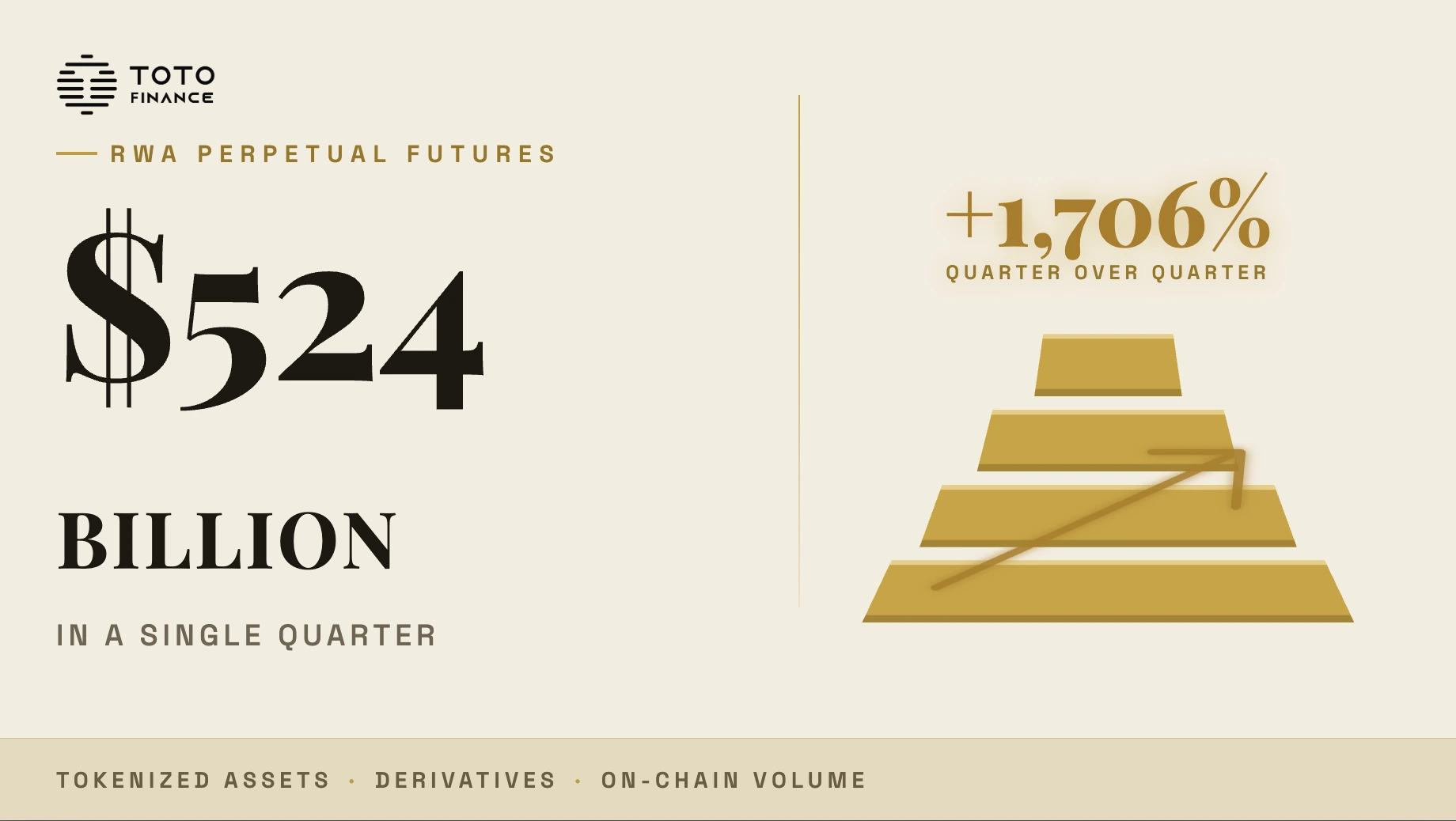
RWA perpetuals, a product category that barely registered on trading dashboards a year ago, recorded $524.79 billion in trading volume in a single quarter. That one quarter exceeded the entire volume of 2025. And by late July 2026, weekly RWA perp volume was sitting at 99.2% of Bitcoin perpetual volume on Hyperliquid and Binance.
This is not a niche experiment anymore. It is a market. And it is worth understanding.
What Is a RWA Perpetual?
A real-world asset perpetual is a perpetual futures contract that gives you leveraged price exposure to traditional assets: gold, silver, crude oil, the S&P 500, individual stocks like Nvidia or Tesla, all settled on-chain in stablecoins, with no expiry date and no physical delivery.
The key distinction from tokenized assets is that RWA perps skip custody entirely. You do not own the underlying asset. You have price exposure to it. No brokerage account. No geographic restrictions. No waiting for Monday morning.
You trade. 24 hours a day. Seven days a week.
That accessibility is the core product insight, and the market has now validated it at scale.
The Growth Curve That Broke Every Chart
The quarterly volume progression tells the story better than anything else:
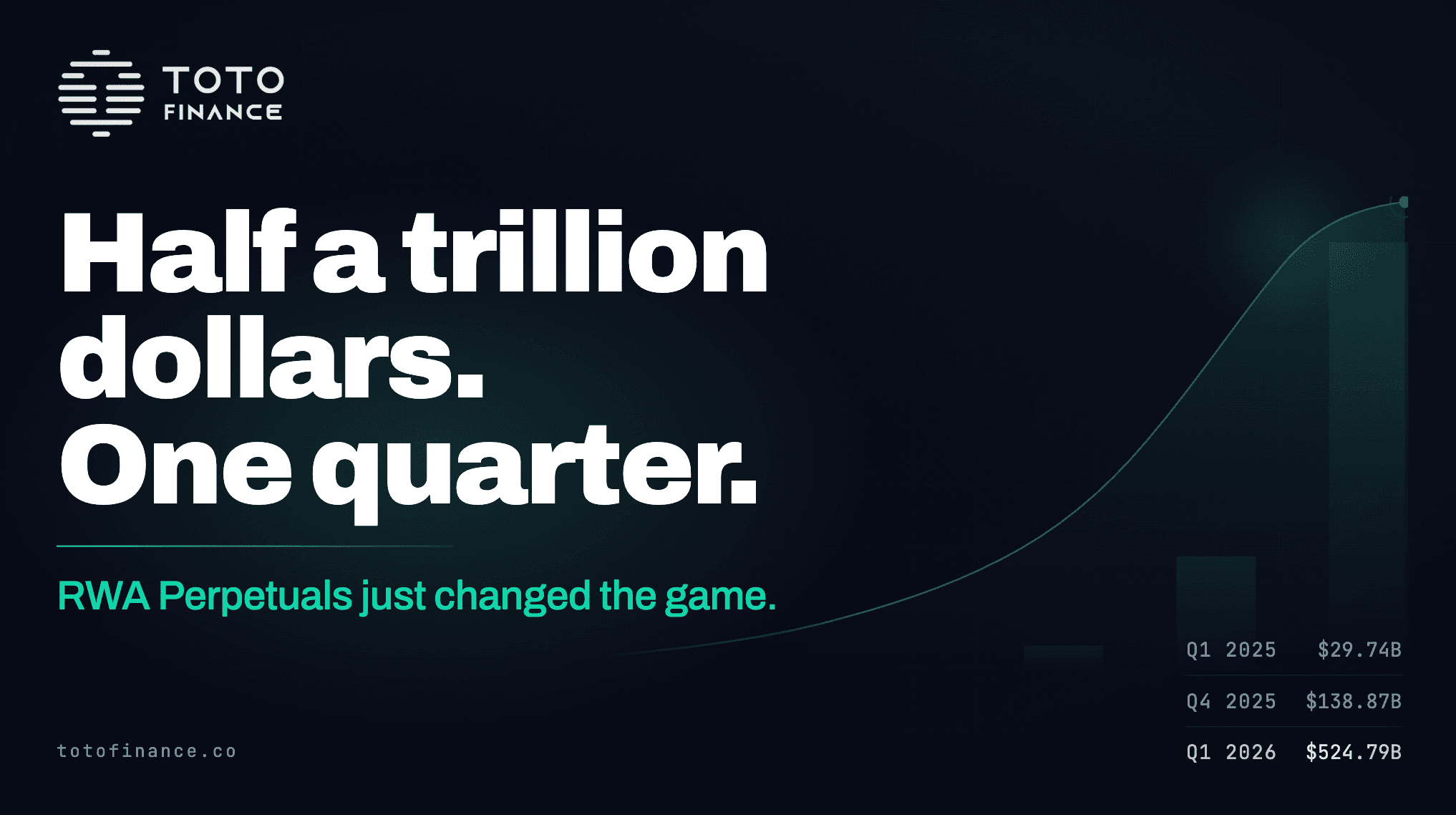
Q1 2025: $29.74 billion Q2 2025: $67.41 billion Q3 2025: $77 billion Q4 2025: $138.87 billion Q1 2026: $524.79 billion
Four consecutive quarters of steady growth, followed by a jump that nearly quadrupled the previous quarter in a single period. According to CoinGecko’s RWA Report 2026, Q1 2026 alone was already 67.7% higher than all of 2025 combined.
Daily open interest tells the same story. RWA perps’ total daily open interest grew from $0.14 billion on January 1, 2025 to $6.68 billion by March 31, 2026. That is a 47x increase in 15 months.
By May 2026, monthly RWA perp volume had reached $347 billion, representing an increase of 1,472x from the $230 million recorded at the start of 2025. And by late July 2026, the weekly run rate had RWA perps at 99.2% of Bitcoin perpetual volume on the two biggest venues in the market.
The Two Platforms Doing the Heavy Lifting
Binance launched gold and silver perpetuals in January 2026 through its Abu Dhabi regulated entity. XAU and XAG contracts against USDT quickly became among the most traded products on the platform. By May 2026, Binance held 55.7% market share in the RWA perps category.
Hyperliquid has been the decentralized standout. Their HIP-3 framework, which lets independent builders deploy their own perpetual markets on Hyperliquid’s infrastructure, enabled rapid expansion into crude oil, S&P 500 contracts, pre-IPO names, and precious metals. Hyperliquid’s RWA perp volume went from $12.65 billion in Q4 2025 to $130.87 billion in Q1 2026. By Q2 2026, RWA perpetuals represented 32.2% of total Hyperliquid trading volume, up from 2% at the start of 2026.
By the week of July 13 to 19, Hyperliquid recorded $25.1 billion in RWA perpetual trading volume alone, exceeding the combined volume of every other perpetual category on the platform.
Together, Binance and Hyperliquid account for over 84% of the market. The concentration creates efficiency, but also introduces platform risk that the market will need to address as it matures.
Why Commodities Lead the Category
Of all the asset classes being traded as RWA perps, commodities make the most intuitive case.
Gold and silver do not have office hours. Geopolitical events happen on weekends. Inflation data releases at 8:30 AM but the reaction trades continue for days. Agricultural supply shocks do not wait for the Chicago Mercantile Exchange to open.
Traditional commodity markets are closed for most of that time. Tokenized commodity perpetuals are not.
During the Iran conflict in early 2026, daily precious metal perp volume on Hyperliquid crossed $1.3 billion as traders rushed for real-time safe-haven exposure. The traditional gold market was closed on weekends. The on-chain market was not. That is a structural advantage that does not disappear when geopolitical tensions ease.
Commodities represented 28.2% of tracked RWA perp volume in late July 2026, behind equities at 57.8% but growing. The equity share is larger today, but the commodity case is arguably more fundamental.
Institutional Capital Is Arriving
The retail demand was always obvious. What is new is the institutional signal.
Variational raised $50 million in May 2026, led by Dragonfly Capital with participation from Bain Capital Crypto and Coinbase Ventures. Their specific focus: perpetuals infrastructure for gold, silver, copper, and WTI crude oil. That is tier-one institutional capital going directly into on-chain commodity derivatives.
Pantera Capital published a research note in July 2026 arguing that perpetual futures could become a dominant trading instrument beyond crypto entirely, citing 24/7 trading, the absence of contract expiries, simpler position management, and continuous price discovery as structural advantages over traditional futures.
Even the Intercontinental Exchange CEO Jeffrey Sprecher, who runs the New York Stock Exchange, has publicly called for regulators to create a level playing field for 24/7 on-chain perpetual futures, acknowledging that blockchain-based trading should not be blocked by legacy market structure rules.
The Infrastructure Question
Here is the part most coverage misses.
RWA perps are only as credible as the assets underlying them. A gold perpetual is only as reliable as the gold backing the spot token. A copper perp is only as legitimate as the physical copper in audited, regulated custody with on-chain proof of reserves.
The trading layer attracts the attention and the volume. But the physical asset layer is what makes it trustworthy and sustainable long term.
This is exactly where Toto Finance sits. We build the physical commodity foundation. Real assets. On-chain. Verified. The infrastructure that makes the trading layer above it credible.
As RWA perps scale, the premium on verified, audited, on-chain physical commodity backing only increases. The market is going to demand it.
Conclusion
From $29 billion in Q1 2025 to $524 billion in Q1 2026. From a niche category to nearly matching Bitcoin perp volume in a single week by July 2026.
RWA perpetuals have made their case. The demand for 24/7, borderless, on-chain exposure to real-world commodities and assets is real, large, and growing faster than almost any other category in DeFi.
The infrastructure is being built. The capital is arriving. The trading volume is already here.
At Toto Finance, we are building the physical asset layer that makes all of it possible.
Follow us to stay ahead of what comes next.
Follow Toto Finance on X: @TotoFinance
Tokenization Was Supposed to Democratize Assets. It Quietly Rebuilt the Same Walls

The Best AI Trade of 2026 Isn’t a Chip Stock

Copper Is the New Oil, and You Still Can’t Own It

The Redemption Gap: What Tokenized Gold Platforms Don’t Tell You
The SEC Just Opened the Door to Tokenized Stocks. Commodity Tokenization Was Already Inside.
The Internet Made Information Digital. Blockchain Is Making Ownership Digital.

The IPO Boom Is Here. Why Tokenized Commodities Matter More Than Ever Right Now.
$524 Billion in RWA Perpetual Futures. One Quarter. Here Is What That Actually Means.
A Use Case in Commodity Tokenization: Toto Finance x Zharta