
Copper, Scarcity, and the Role of Tokenization
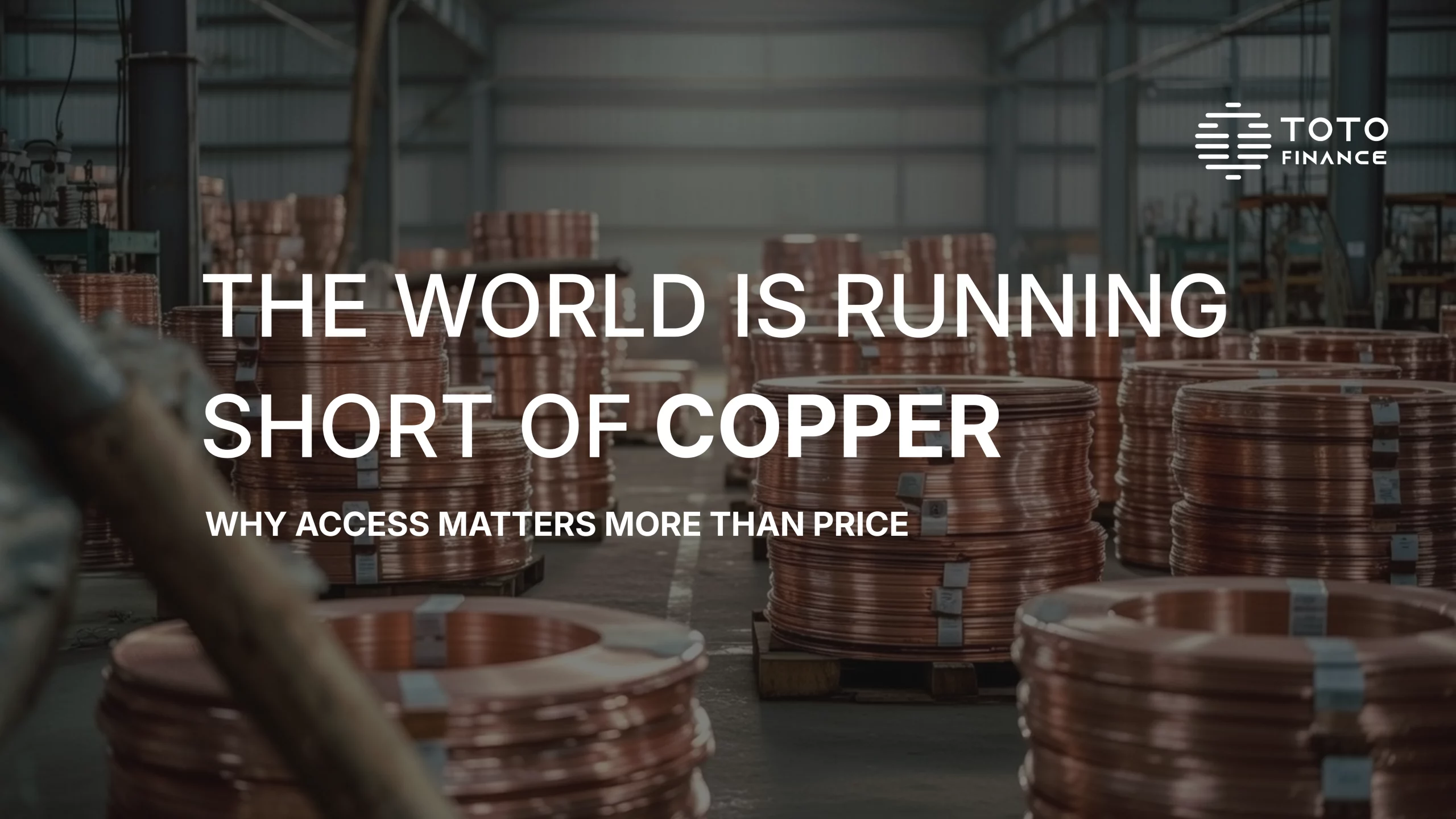
Copper rarely captures headlines the way gold or oil do. Yet over the past weeks, a series of reports, policy discussions, and market signals have brought copper back into focus, not as a cyclical industrial input, but as a strategic constraint on the global economy.
Recent analysis points to a clear conclusion: the world is entering a period where copper demand is structurally outpacing supply. This is not driven by a single trend or policy agenda, but by a convergence of forces: electrification, artificial intelligence, defense spending, infrastructure renewal, and industrial re-shoring.
The core issue is not price volatility.
It is access to a scarce, essential resource.
What Copper Actually Is (and Why It Matters)
Copper is one of the most fundamental materials in modern civilization.
It is indispensable because it combines:
- exceptional electrical conductivity
- corrosion resistance
- durability
- ease of shaping and recycling
Nearly every critical system depends on it: power grids, data centers, electric vehicles, renewable energy installations, transportation networks, and military equipment.
Unlike many commodities, copper has no viable large-scale substitute. When demand rises, it cannot be easily replaced, only sourced, recycled, or rationed.
That makes copper a non-negotiable input for the digital and electrified economy.
Why Copper Markets Are Tightening
Over the past five days, multiple independent analyses converged on the same numbers:
- Global copper demand is projected to rise from roughly 28 million tonnes today to ~42 million tonnes by 2040
- This represents a ~50% increase driven by electrification, AI data centers, defense, robotics, and grid expansion
- At the same time, supply is expected to peak around 2030 and gradually decline thereafter
- Without major new mining investment and recycling capacity, the projected deficit reaches ~10 million tonnes annually by 2040
These projections are not hypothetical scenarios. They are based on base-case assumptions, not aggressive climate targets.
As one recent industry analysis put it: even if net-zero policies stall, copper demand still rises.
The politics of the transition may change.
Physics does not.
Copper as a Strategic Asset
Historically, copper prices have surged during:
- periods of industrialization
- electrification waves
- war and defense build-ups
- post-conflict reconstruction
Today, all four are happening simultaneously at global scale.
Re-industrialization efforts in the US and Europe, defense spending increases, AI infrastructure build-outs, and large-scale reconstruction projects are all competing for the same finite pool of copper.
This shifts copper from a purely industrial commodity into a strategic asset.
When an asset becomes strategic, markets begin to care not just about price, but about security of supply, allocation, and ownership.
Where Traditional Commodity Markets Fall Short
Despite copper’s importance, the way it is accessed and allocated remains largely unchanged:
- opaque inventories
- fragmented custody and warehousing
- slow settlement and reconciliation
- limited transparency for non-industrial participants
- high barriers for smaller or global investors
These frictions were tolerable when supply was abundant.
They become problematic when scarcity emerges.
In a constrained market, who can access copper, “and on what terms”, matters as much as how much it costs.
What Tokenization Can, and Cannot Do
Tokenization does not create copper.
It does not eliminate scarcity.
It does not solve mining constraints.
And it should not pretend to.
Its role is more precise and more valuable.
When applied correctly, tokenization can:
- create a transparent representation layer for physical copper holdings
- enable auditable ownership and transfer history
- reduce settlement friction and reconciliation delays
- improve access without compromising physical backing
- support structured allocation, financing, and collateral use
The token does not replace the warehouse, the miner, or the physical asset.
It organizes access to it.
From Industrial Metal to Infrastructure Asset
As copper becomes strategic, it starts to resemble other real-world assets where trust, verification, and lifecycle management are critical.
This is where lessons from other RWAs, such as carbon credits, precious metals, and energy assets apply directly.
Without verified backing, clear legal frameworks, disciplined custody and enforceable redemption logic any digital representation collapses into speculation.
Tokenization only works when it respects the physical and regulatory reality of the asset.
The Toto Finance Perspective
At Toto Finance, the focus is not on turning commodities into narratives.
It is on building infrastructure that aligns digital ownership with physical reality.
For strategic commodities like copper, this means:
- starting with verifiable physical supply
- enforcing clear custody and ownership rules
- ensuring transparency across the asset lifecycle
- designing access mechanisms that scale without weakening trust
Tokenization is not the product.
Trust-preserving infrastructure is.
Why Copper Matters Beyond Copper
Copper is a case study.
It highlights a broader shift across real-world assets:
scarcity is returning, geopolitics is shaping supply, and access is becoming strategic.
Any platform that can handle copper properly with discipline, verification, and transparency is far more likely to handle other RWAs with the same rigor.
The future of commodities will not be defined by who tells the best story.
It will be defined by who builds the best rails.
The Path Forward
Copper’s trajectory is not cyclical, it is structural.
As demand accelerates and supply tightens, markets will increasingly value:
- reliability over speed
- transparency over opacity
- infrastructure over narratives
Tokenization, when done correctly, supports this transition.
Not by promising abundance, but by managing scarcity responsibly.